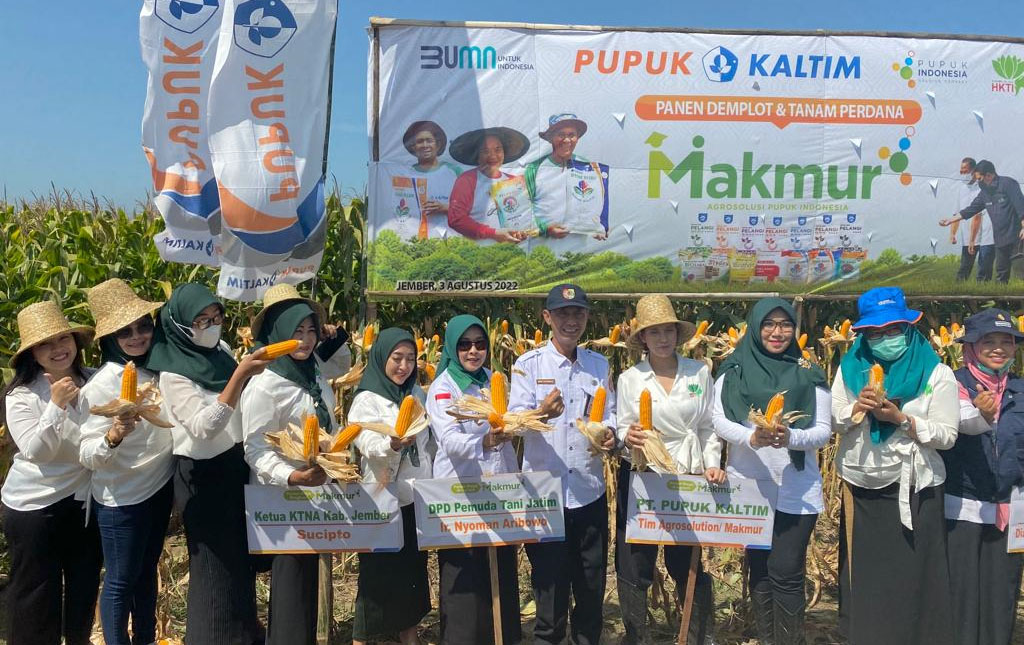
Dian Novita Susanto (General Chairwoman Farmers Association/ Perempuan Tani HKTI)
Presiden Joko Widodo, in his Nawacita document has made food sovereignty as one of the priority programs. The budget for the Ministry of Agriculture has increased many times, reaching the highest in the history of this Republic in 2015. Successively it was:
- 2014 (Rp. 14,23 Trillion),
- 2015 (Rp. 32,72 Trillion),
- 2016 (Rp. 27,72 Trillion),
- 2017 (Rp. 24,22 Trillion),
- 2018 (Rp. 24,03 Trillion),
- 2019 (Rp. 21,71 Trillion).
In his second period, Jokowi still considers the agriculture sector as a priority, particularly in food commodities that are imported in large quantities. For example: maize, soybean, and rice (There is no rice import in the year of 2020); and other commodities that are still imported in the millions. Still, the allocation of state budget (APBN) for this sector is significant in the years of 2020 (Rp. 21,05 Trillion) and 2021 (Rp. 15,51 Trillion).
In the National Working Meeting of Agricultural Development 2021 (Rakernas Pembangunan Pertanian) on January 11, Joko Widodo again reminded the relevant Ministers, especially the Ministry of Agriculture, to coordinate and take the necessary policies in making Indonesia a food sovereign country; even becoming a major world food player, particularly in rice. Jokowi asked for the success of 2020, when there was no rice import, to always be maintained.
However, in early March 2021, the public, especially farmers, were surprised with the Indonesian government’s plan to import rice amounting up to 1 million tons. Meanwhile, the Central Bureau of Statistic (BPS) estimates the production of rice during the period of January – April 2021 is quite high at 14,54 million tons. This is an increase of 26,84 percent compared to the production of rice over the same period of 2020 that only produced 11,46 million tons. The Central Bureau of Statistic also calculates the main harvest in the same months at more or less 4,8 million tons.
The government’s import policy plan immediately received negative reactions from the farmers, academics, agricultural practitioners, and also from the non-governmental organizations focusing on agriculture. They all voiced their opposition. Their argument is based on the fact that the main harvest has begun, with its peak in April; and that import will negatively impact the price of grain as not all the farmers’ grains can be absorbed by the Logistics Affairs Business Entity (Bulog). This obviously will have adverse impacts on rice farmers.
Still Dependant On Imports
In the history of the Indonesian government, rice commodity always been a priority. In this case, the focus of the strategy of the Indonesian rice policy is to increase production in order to meet the food needs of the country.
Rice is not only a strategic commodity in national development because it is a major food commodity that must be available in large quantities; it is also the source of income and employment particularly in the countryside. However rice in Indonesia has become a political commodity with complex dimensions.
Despite the Covid-19 pandemic, the agriculture sector is growing and positively contributing to the national economy. However, rice import will most likely happen in 2021. If we look back, indeed in the Jokowi’s administration has recorded several imports:
- 2015 (861 thousand tons),
- 2016 (1,28 million tons)
- 2017 (305 thousand tons)
- 2018 (2,25 million tons – reaching its peak)
- 2019 (444 thousand tons, a dramatic decrease of 80,3 percent from the previous year)
In reality, only in 2020 Indonesia did not import rice.
The rice import policy in Indonesia involves a number of institutions and Ministries, amongst others: The Ministry of Agriculture, The Ministry of Trade, Logistics Affairs Business Entity (Bulog), House of Representatives (DPR) and the Central Bureau of Statistic (BPS). The rice import policy in Jokowi’s administration has always been colored with the pros and cons by these institutions. Each of them has different sets of data that are counter-productive, resulting in a prolonged polemic regarding rice imports.
The import policy sometimes that raises pros and cons between these relevant institution, is a strong indication that rice import policy is not supported by accurate data analysis through academic studies. On the contrary, the rice import policy has become a mostly political agenda related to the conflicts of interests between the groups or actors that are involved. Namely: the Ministry of Trade, Ministry of Agriculture, Logistics Affairs Business Entity (Bulog), House of Representatives (DPR), and Central Bureau of Statistics (BPS). This assumption is based on the different rice data that exists amongst these institutions.
In analyzing the rice import policy that has been made by the government, the main point of concern is the policy making process itself. It cannot be denied that in any policy making of a country, there is a struggle between interest groups both in government and those acting as a pressure groups. Government, in this case is represented by The Ministry of Agriculture, Ministry of Trade, Bulog, DPR who represent the national interests. On the other side, there are rice farmers’ associations who represent their own interests. Therefore, the complexity of the relationships and the conflicts of interest certainly creates pros and cons in rice import policy. This is made worse when there is no synchronization of data.
The importance of the Data Transparency
It is important for the relevant stakeholders, through The Ministry of Economic Coordination to coordinate this case with The Ministry of Agriculture, Ministry of Trade, Bulog, BPS, and including DPR RI to sit together and open the actual data such as rice production, rice reserves, needs, and the price.
This transparency is required so that there is no erroneous import policy. Imports should only done when the reserves are insufficient and should not be done during the main harvest season. So, the government should be very cautious before deciding on imports as farmers will be badly affected. Even though the government and/or Bulog may feel that reserves are insufficient, imports may only be done in September when traditionally, production starts to decline.
And if it turns out there is enough reserves, what is the purpose for this import policy and for whom? Because it is in stark contrast with the spirit of President Joko Widodo whose has always called for food sovereignty and the welfare of farmers.